Distributed Sheaf Solve
Coordinating a fleet on a cellular sheaf reduces, at every control step, to one linear system, the harmonic extension
\[H\, q^\star = -B\, p,\]
where $H$ is the agent block of the sheaf Laplacian and $p$ the current target positions. This feature solves that system exactly, and in a distributed way. The factor of $H$ is computed once, cut into per-worker slices along its elimination tree, and each solve is a short message-passing protocol, so no machine ever holds the whole problem.
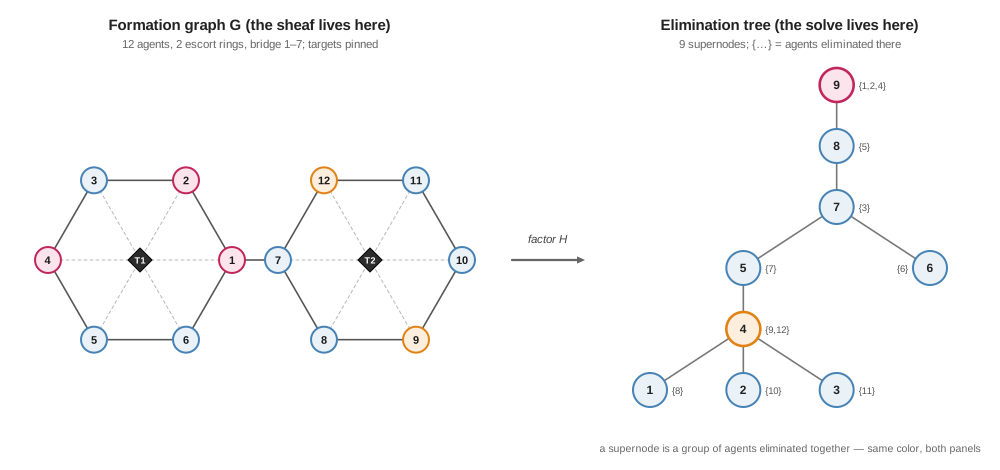
The claims, and where each is established
| claim | where |
|---|---|
| Coordination is one SPD solve, and moving targets change only the right-hand side | Coordination as a harmonic extension |
| The multifrontal factorization organizes that solve per supernode, with disjoint ownership | The multifrontal factorization |
| The tree can be cut across machines, and the cross-cut messages are small and provably sufficient | Distributing the solve |
| Under one fair radio model, it beats a centralized coordinator and accelerated diffusion by 10–36×, with measured caveats | Three methods, one communication model |
| Exact to $10^{-16}$, $O(\log n)$ slots under nested dissection, 12% worst-case memory per agent | Benchmarks |
| How to call all of it | Usage and API |
The worked example, Distributed Harmonic Extension: Tracking Without a Central Solver, runs the full pipeline on twelve simulated agents across three real processes and matches the central answer to $8.9\times10^{-16}$.
What it provides
distributed_tree_solve, the multi-process solve: one chunk of the factor per worker, boundary corrections overRemoteChannels.partition_tree/worker_factorization, the minimally-cut connected partition and each worker's self-contained slice.TreeWorkspacewith three-argumenttree_forward_ldiv!/tree_backward_ldiv!, the allocation-free cached re-solve for the per-step tracking loop.
Why this is not "just call a sparse solver"
A monolithic sparse Cholesky stores its factor on one node and threads its solve through one shared stack, and neither survives being split across machines. The work here is doing the identical arithmetic with the tree cut into pieces: same answer to machine precision, but the memory, the factor, and the communication are all decentralized. The communication scales with the tree's depth, which the elimination ordering keeps logarithmic, rather than with the size of the fleet.