Restriction Map Type Comparison
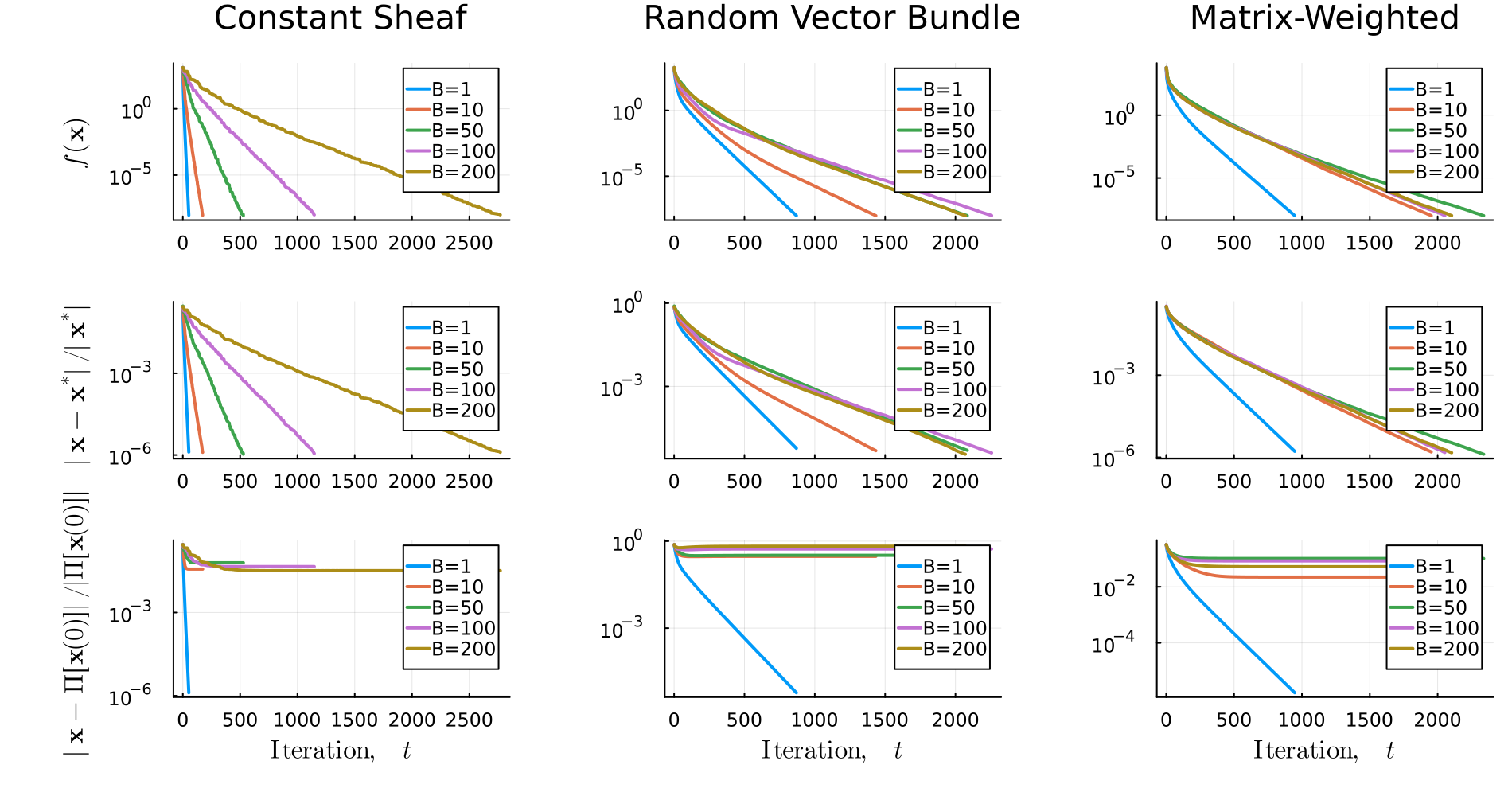
The structure of a sheaf's restriction maps determines how information is aggregated across edges. This experiment compares three sheaf types on a 4-regular graph with $n=20$ agents and stalk dimension 4, all diffused with the same mixture-model asynchronous schedule ($B=200$):
- Constant sheaf: identity restriction maps — each vertex sees the same information at both endpoints of each edge. Global sections are constant signals.
- Random vector bundle: semi-orthogonal restriction maps — models a principal bundle where the fiber is rotated across each edge.
- Matrix-weighted: restriction maps derived from random PD/PSD matrices — models asymmetric information blending, relevant to network opinion dynamics.
For each sheaf type we plot energy $f(\mathbf{x}(t))$, relative error $\|\mathbf{x}(t) - \mathbf{x}^*\| / \|\mathbf{x}^*\|$, and orthogonal projection error $\|\mathbf{x}(t) - \Pi_\Gamma[\mathbf{x}(0)]\| / \|\Pi_\Gamma[\mathbf{x}(0)]\|$.
Data source: Pre-generated by docs/scripts/acc26_experiments.jl. To regenerate the data and re-render the figure, run:
julia --project=docs docs/scripts/acc26_experiments.jl
julia --project=docs docs/scripts/generate_figures.jl