PERT Networks
A PERT network encodes a project as a vertex-weighted graph $G = (V, E, w)$.
- vertices $i \in V$ represent tasks.
- edges $(i, j) \in E$ represent precedence constraints: task $i$ must finish before task $j$ can start.
- vertex weights $w_i \in [0, \infty]$ represent durations: task $i$ takes $w_i$ days to complete.
The figure below shows a PERT network with eight tasks and ten precedence constraints.
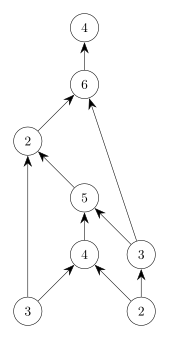
We can represent the network as a matrix $A: V \times V \to [-\infty, \infty]$, where
\[A_{ij} = \begin{cases} w_i &\text{if } (i, j) \in E \\ -\infty &\text{if } (i, j) \notin E \end{cases}\]
for all pairs of tasks $(i, j) \in V \times V$.
using SemiringFactorizations, SparseArrays

# max-plus semiring
const MP = MaxPlus{Float64}

# durations
w = MP[3, 2, 4, 3, 5, 2, 6, 4]

# precedence constraints
#    1  1  2  2  3  4  4  5  6  7
#    ↓  ↓  ↓  ↓  ↓  ↓  ↓  ↓  ↓  ↓
#    3  6  3  4  5  7  5  6  7  8
I = [1, 1, 2, 2, 3, 4, 4, 5, 6, 7]
J = [3, 6, 3, 4, 5, 7, 5, 6, 7, 8]

A = sparse(I, J, w[I], 8, 8)
8×8 SparseArrays.SparseMatrixCSC{MaxPlus{Float64}, Int64} with 10 stored entries:
⋅ ⋅ 3.0 ⋅ ⋅ 3.0 ⋅ ⋅
⋅ ⋅ 2.0 2.0 ⋅ ⋅ ⋅ ⋅
⋅ ⋅ ⋅ ⋅ 4.0 ⋅ ⋅ ⋅
⋅ ⋅ ⋅ ⋅ 3.0 ⋅ 3.0 ⋅
⋅ ⋅ ⋅ ⋅ ⋅ 5.0 ⋅ ⋅
⋅ ⋅ ⋅ ⋅ ⋅ ⋅ 2.0 ⋅
⋅ ⋅ ⋅ ⋅ ⋅ ⋅ ⋅ 6.0
⋅ ⋅ ⋅ ⋅ ⋅ ⋅ ⋅ ⋅ The Kleene star of $A$ is a matrix $A^*: V \times V \to [-\infty, \infty]$ whose entry
\[A^*_{ij} \in [-\infty, \infty]\]
is equal to the shortest possible interval between the start of $i$ and the start of $j$. In particular, if $j$ can precede $i$, then $A^*_{ij} = -\infty$. We can compute $A^*$ explicitly using the function star.
star(A)8×8 Matrix{MaxPlus{Float64}}:
0.0 -Inf 3.0 -Inf 7.0 12.0 14.0 20.0
-Inf 0.0 2.0 2.0 6.0 11.0 13.0 19.0
-Inf -Inf 0.0 -Inf 4.0 9.0 11.0 17.0
-Inf -Inf -Inf 0.0 3.0 8.0 10.0 16.0
-Inf -Inf -Inf -Inf 0.0 5.0 7.0 13.0
-Inf -Inf -Inf -Inf -Inf 0.0 2.0 8.0
-Inf -Inf -Inf -Inf -Inf -Inf 0.0 6.0
-Inf -Inf -Inf -Inf -Inf -Inf -Inf 0.0Alternatively, we can compute a factorized representation of $A^*$ using the function slu. This approach is generally faster than the previous one.
K = slu(A)SparseStarLU{MaxPlus{Float64}, Int64}:
maximum front-size: 4
structural nonzeros: 34Scheduling
We will also distinguish two sets of tasks.
- start tasks: $S \subseteq V$
- final tasks: $F \subseteq V$
Our goal is to complete the tasks in $F$, starting with the tasks in $S$.
S = [1, 2]; F = [8];We can represent $S$ as a vector $s: V \to [-\infty, \infty]$, where
\[s_i = \begin{cases} 0 &\text{if } i \in S \\ -\infty &\text{if } i \notin S \end{cases}\]
s = zeros(MP, 8); s[S] .= 0
s
8-element Vector{MaxPlus{Float64}}:
0.0
0.0
-Inf
-Inf
-Inf
-Inf
-Inf
-InfWe can represent $F$ as a vector $f: V \to [-\infty, \infty]$, where
\[f_i = \begin{cases} w_i &\text{if } i \in F \\ -\infty &\text{if } i \notin F \end{cases}\]
f = zeros(MP, 8); f[F] .= w[F]
f
8-element Vector{MaxPlus{Float64}}:
-Inf
-Inf
-Inf
-Inf
-Inf
-Inf
-Inf
4.0Earliest Start and Finish Times
For all tasks $i \in V$, the earliest start time
\[s^e_i \in [0, \infty]\]
is the earliest time that $i$ can begin.
se = transpose(transpose(s) * K)8-element Vector{MaxPlus{Float64}}:
0.0
0.0
3.0
2.0
7.0
12.0
14.0
20.0The earliest finish time
\[f^e_i \in [0, \infty]\]
is the earliest time that $i$ can be completed.
fe = se .* w8-element Vector{MaxPlus{Float64}}:
3.0
2.0
7.0
5.0
12.0
14.0
20.0
24.0Makespan
The makespan is the earliest that the project can be completed. If the project takes longer than this time, then it is behind schedule.
c = transpose(se) * f24.0Latest Start and Finish Times
For all tasks $i \in V$, the latest start time
\[ s^l_i \in [0, \infty]\]
is the latest time that $i$ can begin without the project falling behind schedule.
sl = transpose(c / (K * f))8-element Vector{MaxPlus{Float64}}:
0.0
1.0
3.0
4.0
7.0
12.0
14.0
20.0The latest finish time
\[ f^l_i \in [0, \infty]\]
is the latest time that $i$ can finish without the project falling behind schedule.
fl = sl .* w8-element Vector{MaxPlus{Float64}}:
3.0
3.0
7.0
7.0
12.0
14.0
20.0
24.0Slack and Critical Tasks
For all tasks $i \in V$, the difference
\[ s^l_i - s^e_i \in [0, \infty]\]
is called the slack at $i$. It encodes how long $i$ can be delayed before the project falls behind schedule.
slack = sl ./ se8-element Vector{MaxPlus{Float64}}:
0.0
1.0
0.0
2.0
0.0
0.0
0.0
0.0A task $i \in V$ is called critical if its slack is zero. Critical tasks cannot be delayed without delaying the whole project.
critical = findall(isone, slack)6-element Vector{Int64}:
1
3
5
6
7
8This page was generated using Literate.jl.